
4 Principles For Adaptive Leadership

When considering the qualities needed to lead an organization, especially in times of disruption and uncertainty, the ability to adapt is often one of the most coveted qualities for leaders. As such, I’ve reflected on the tremendous amount of change and adversity that we have collectively faced as a result of the challenging but necessary COVID-19 lockdowns. In the past months, just as businesses were on the cusp of returning to the office and resuming normal routines, the Delta variant quickly demanded laborers and managers to alter their course and reconsider how to keep employees safe.

This is only one of the more recent examples of the disruption we have experienced in the past two tumultuous years. Factors like variants and spikes in infections make it apparent that this need for an adaptable and responsive approach to leadership will continue to be the norm. But one thing that will impede progress and growth is panic. With this in mind, I believe that leaders and managers must take a step back to look at the full-wide picture before proceeding with new strategies moving forward. 

But simply being able to “adapt” or showing “adaptive actions” is not enough: organizations that wish to employ an adaptive leadership style must cultivate a few key characteristics to ensure optimal performance. In recent years, many business leaders have realized that the single-figure, top-down leadership model is outdated and impractical. No single person can solve every problem, which brings in the need for adaptive and collaborative leadership.

While leadership styles have been transformed over time throughout the years, adaptive leadership, in particular, embraces learning and continuous growth. Leaders shouldn’t be afraid to try new tactics to solve problems. They should also encourage innovation and creativity from their employees, even if the solutions don’t always work.

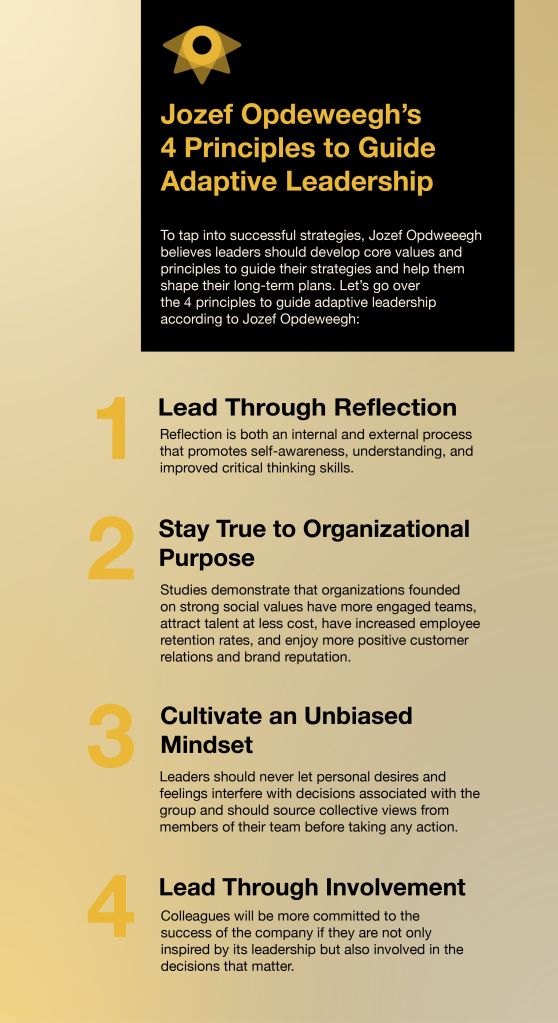
Let’s go over the 4 principles to guide adaptive leadership: 

  1. Leading Through Reflection

Reflection is both an internal and external process that promotes self-awareness, understanding, and improved critical thinking skills. Learning to be present, aware, and attentive to our experience and interactions with people throughout the day is an important element of adaptive leadership.

  1. Developing Clear Organizational Purpose

Studies and surveys demonstrate that organizations founded on strong social values have more engaged teams, attract talent at less cost, have increased employee retention rates, and enjoy more positive customer relations and brand reputation. Leadership in the next decade will require greater attention to these issues, not only as a requisite of political correctness but as a means to drive performance.

  1. Cultivating an Unbiased Mindset

An ideal group leader should take a selfless and unbiased approach to leadership and credit the company’s success to the contributions of every member and not himself alone. As such, leaders should never let personal desires and feelings interfere with decisions associated with the group and should source collective views from members of their team before taking any action.

  1. Leading With Empathy

Employees will be more committed to the success of the company if they feel inspired by leadership. A successful company generally boasts a roster of employees who enjoy working there. Giving employees a voice, equipping them with the knowledge they need to succeed, and inspiring them to drive the company forward is beneficial to the company at large. 
Demanding the truth

New subordinate looking at hospitable boss welcoming her to take her workplace

Modern physics tells us that all reactions and events are a consequence of four fundamental forces of nature. Three of these – electromagnetism, the strong and weak nuclear forces – are not immediately obvious to the layperson. Despite the growth of popular science, most of us don’t pretend to fully understand the complexities they involve. But the fourth force – gravity – is not only all around us, it’s intuitive to the way we live our everyday lives. 

All of us, at least from an early age, understand that if we drop a cup of water its contents will spill to the floor. We also know that although gravity may appear weak, it’s ultimately insistent. It takes the weight of the world to keep my laptop anchored to my desk, and yet I can lift it with ease—or at least, I can for a while! Try holding your arm at shoulder height without assistance and see how long you last… Nothing escapes gravity, least of all our vanity in thinking we might cheat it.

I open with this metaphor to science, because I like to think that over recent months, we’ve been witnessing a pull of a different sort. In domestic politics, the Coronavirus pandemic, the environmental crisis, and even the world of sport, I sense the persistence of truth weighing ever heavier on those who would seek to cheat us (and perhaps themselves) with illusions and lies. 

As I write, the UK is in political turmoil over the behaviour of those in positions of power during the lockdowns of 2020; in the US we are seeing something of the equivalent as more facts surface about the practices and character of our last administration. Only last week, in a bizarre series of events, we saw the undoing of Novak Djokovic in the face of evidence that even he couldn’t ‘wish away, no matter how strong his will to win. 

These are topical and even somewhat humorous examples of what some might consider being a long-overdue comeuppance. But the malaise of self-deception—as well as that of misleading others—is one that afflicts many businesses and their leaders too. Most often, I sense it’s not so much a matter of intent to deceive, and even less so of malice or prejudice. Rather, the denial of facts in our strategies and predictions stems from a mixture of wishful thinking, confirmation bias, and even good old-fashioned pride.  

Which as we know, often comes before a fall!

The deep truth is that facts, like gravity, will inevitably win out. Markets in structural decline cannot will themselves to grow; organizations with toxic values cannot tweak them into acceptability; and while chasing unprofitable business may shore up the top line, it will surely tell a different story in the end. As one of my former colleagues used to say, ‘we must face reality as it is — not as it was, or we would wish it to be.’

Telling the truth, especially when others don’t want to hear it, can take real courage. Typically it is easier to sugar the pill, and of course, in our personal friendships, there are times when we might judiciously keep our counsel. But when we have a formal responsibility to others, it’s vital that we ground our decisions (and the actions which follow) in our best judgment of the facts as we see them. 

Objectivity, analysis, and truth to data are as integral to good leadership as are inspirational words and a compassionate spirit. We may convince ourselves otherwise, but awaiting our self-deceit will be what the Greeks knew as nemesis: the inescapable downfall that is the consequence of our arrogance. 

The good news is that our nose for the truth is intuitive too. Following it isn’t complex; we know when we are deceiving ourselves, or hoping, fingers crossed, for a miracle to save the day. And so it should be no surprise that others can sense this too. Those leaders who act with honesty and integrity in the face of vested interests or established dogma will be rewarded with loyalty and admiration that in the long run gives them leeway for the mistakes that all of us inevitably make. 

But if staying’ true to facts’ is one of the hardest qualities of leadership, then so too is being open to opinions and ideas that challenge our perceptions. I don’t believe that truth is relative – at least not in the context under discussion here—but I do recognize that none of us has a monopoly of it. Our job as leaders, like that of scientists, is to listen, observe and make decisions based on the best available evidence. In that way, our failures, as well as our successes, can add to the body of knowledge, so long as we declare them both for what they are. 

I remember at junior school being told the story of Isaac Newton’s epiphany as an apple fell from a tree to hit his head. Whether that tale is fact or myth doesn’t really matter; what’s important is that it helped to explain a phenomenon that we instinctively knew to be there. Perhaps, to understand the power of truth, we need to see more high-profile exposures; more of our politicians, businesses, and even some of our supposed sporting heroes shown to be what they are. Only then can we appreciate our world as it truly is —the good and the bad; the honest and the cheats; the facts and the lies.  These are the forces of ‘our nature’, playing out in the harmonies and discords around us every day. But for all the clatter they create, it is the bass note of truth which, like the pull of gravity, quietly and insistently sets the tone and tempo of progress for the good. We do well to listen out for it among the noise.

Leadership Defined

How might we define leadership?

This is a question I’m often asked, and especially so since I wrote my book Fair Value – reflections on good business.  Behind the inquiries, there is a sense of a wish to make the process of learning to lead more formulaic and less intuitive. That my book was primarily about values and their adaptability doesn’t satisfy their desire for clarity. It seems that we are comfortable with the idea that values can be subjective, but in the case of leadership we want to pin it down, identify its essential traits, so we can measure and monitor our progress.

Last week, I was listening to a podcast by Ben Morton interviewing the colossus in the world of leadership that is Jim Kouzes. In his book, The Leadership Challenge, co-written with Barry Posner, they define the process of leadership as ‘the art of mobilizing others to want to struggle for shared aspirations.’  That seems about as good as it gets, and I’d encourage you to check out any of their publications, or indeed listen to Ben’s excellent podcast conversation. 

And yet, I’m still uneasy with definitions of this sort.

What is leadership?

In fairness to Kouzes and Posner there is much more to their work than a mere definition. As experienced researchers, they recognize the need for flexibility, and it’s surely significant that their headline summary describes leadership as an ‘art’ not a science.  Furthermore, their model identifies five exemplary practices that include role modeling, vision, challenge, enablement, and engaging the heart! In many ways, the practice of these tenets is similar to the principles of virtue theory – the idea that we learn to be good citizens, not so much by following strict doctrine as by demonstrating good behavior in, or daily lives. 

In a different context, I was reflecting on this difference after listening to Malcom Gladwell’s superb Miracle and Wonder: Conversations with Paul Simon. In the academic tradition, the learning of an instrument goes hand in hand with an understanding of musical theory, the relationship of chords and their progressions, harmonies, structure… And yet there are others, like Simon, who play largely by ear, their genius guided by an intuition of what sounds right rather than any set formula.  At the apogee of attainment, there is invariably a fusion of the two. 

And it’s this goal of a synthesis that shapes my personal sense of leadership and values. 

Leadership Tenets and Intuitive are Key

The two aspects tenets and intuitive seems to me, are indivisible —indeed, more than that, they cannot properly exist without each other. For if we were to take Kouzes’ definition above — and strip it of any element of virtue —then we might reasonably conclude that Stalin or Hitler are as equally great in their leadership qualities as, say, George Washington or Mahatma Gandhi. Some dry academics might be comfortable with that assessment, but I’d counter that it’s not how we think and act in everyday life. In practice, we describe the former as despots and the latter as heroes, whose qualities we admire and seek to emulate.

And the key difference is in the values they lived by.

Leadership Should be Symbiotic and Sustainable

A while ago I took a walk outside the city and on the trees and rocks were many lichens. For centuries, we regarded these humble organisms as a sort of plant, and superficially it’s true that they look a little like moss. But, in fact, we now know that they are a combination of a fungus and an alga — a symbiotic life form that exists only because each plays its part. Interestingly, they are a superb indicator of our air quality, almost indestructible but flourishing most when environmental conditions are right. As an allegory for sustainable leadership, there are few better examples.

That’s a somewhat lyrical note to conclude on. But my point is that perhaps we need to see leadership and values in a more expressive and emotional light. For I believe it is the subjective and yet intuitively right elements that are most critical for our understanding of the terms. In their search for clarity, this answer may not be what my enquirers expected, or indeed hoped, to find. But the truth is the best definitions are not just linguistically tight, rather, they are those that are most deeply felt. 

Thinking The Unthinkable

COVID-19 Pandemic Changes the Landscape

Across Europe and North America, political leaders are beginning to think the unthinkable. Two years ago, the suggestion that we would need medical passes to travel, attend events, or enter a restaurant, would have been shuddered at. Today these measures are commonplace, and the scope of sanctions for those who won’t play ball is getting ever wider. What’s more, the prospect of mandatory vaccination— a line that none of us could have imagined would be crossed—is now considered by many to be both necessary and urgent.

My interest here is not so much in arguing for a particular path, as in exploring how we best find a way through. Whatever our views on the rights and wrongs of the options, we cannot simply shirk the debate—for like the virus, it is already out there. The implications for the role of leaders—and the values they espouse—are therefore profound. 

But first, let me return briefly to the pandemic. 

Body Autonomy has been a Hallmark of Liberal Democracy

There is a long and deeply held tradition in liberal democracies that compulsory medical treatment is a line we do not cross. Citizens it is claimed, have the right to make their own decisions about their bodies, even if they make objectively poor ones. The role of the State is to provide information and even to persuade, but (with a few extreme exceptions) not to compel, either directly or indirectly through the imposition of coercive sanctions.  

And in normal circumstances, most of us would agree.

Citizenship Means Duty

But in times of crisis, the contrary view would home in on that word ‘citizen’. Our societies are collective endeavors and cannot be meaningfully reduced to supposedly independent individuals. Free riders who take of society’s benefits without appropriate contribution are universally disparaged. Furthermore, in the democratic West, there’s an equally long and deeply held tradition that the exercise of our liberty should always be limited to the extent it impinges on the freedom of others. 

And so, we have a values stand-off. On the one hand, there is the sense that there ought to be limitations to the State. On the other, growing anger that the actions of a minority are impacting our collective wellbeing. It’s a classic political and moral dilemma: the idea of medical compulsion is uncomfortable, but so too are the restrictions that everyone must endure because of a resistant minority.

What does all this mean for leadership?

I believe it was right for our governments to first pursue a strategy based on information and persuasion. Good leadership does not seek out conflict for its own sake and if momentum can be achieved without confrontation then so much the better. In this regard, trust in both the messages and the messengers is essential, and sadly, politics being what it is, this has been undermined all too often. 

It seems to me that the values which are typical of most progressive companies would have been excellent creeds for our politicians to have lived by: transparency, togetherness, speed and service to others… these, and many similar standards, will be familiar to anyone with experience of modern organizations.

What if persuasion is not enough?

Over the last few weeks, we have seen countries in Europe and jurisdictions here in the US take increasingly strident lines. Austria will compel vaccinations from early next year while Germany is openly discussing similar measures; in France, the pass sanitaire is becoming essential for all but the most basic of needs. Even in the UK, one of the most reluctant countries in this regard, there is no mention of the need for a national debate. 

And surely here is where leadership has the most crucial role to play. 

Leaders Should Facilitate Discussion

For it is essential, in these circumstances, that leaders proactively facilitate an inclusive discussion, ensuring all sides have the opportunity to speak their truth. This process should not be used to delay decisions or abnegate responsibility for their taking, nor should it be the genesis of a fudge that pleases no one. Rather, it’s about using leadership as means to respectful understanding, which more than anything requires careful listening and consideration—before then acting decisively.  

Roadmap of Rewards

And in that regard, the positive consequences of the action that’s chosen should also be made clear. In leading through divisive issues, we have a responsibility to set out a ‘roadmap of rewards’, showing the milestones ahead and the benefits that will be shared on reaching them. There will always be a resistant few, but our best hope of reaching out to those who are not entirely inflexible is by being transparent about the critical junctions and decision points we face. If progress is not as we had hoped, leaders might reasonably commit to revisit and reconsider in light of those circumstances. 

Leaders Have to Act on Imperfect Information

But a word of warning here. That willingness to reconsider should not be at the expense of a steadfast determination to follow a chosen path. Ultimately, no decision of this sort can be scientifically proven. As leaders, we must at times rely on ‘value judgements’ and the clue to the best of these is in the name. Decisions arrived at with sound reasoning and rooted in commonly held standards and are not guaranteed to succeed, but having made them, we should hold firm until evidence suggests otherwise. 

It’s often said that we are all leaders, and in the context of complex organizations this is undoubtedly true in the sense that we must each take responsibility for our actions. This must not, however, be misinterpreted as permission to act the maverick or undermine policies that have been fairly talked through. Leadership at an individual level is about actively contributing to a collective success even if the strategy is one that you might prefer to be different. If that policy is too far removed from your own values, then it’s time to move on. 

If that is difficult to contemplate, it is but a precursor to some issues we may soon have to face. I sense the next few months are likely to see us in political and moral territories that were unimaginable not so long ago. At times like these, leaders are wise to remember Rudyard Kipling’s poem If, which reminds us to …trust yourself when all men doubt you/ But make allowance for their doubting too…   Whatever paths we chose, I sense, like the crossing of the Rubicon, that there will be no going back. Perhaps more than anything these moments require us to show bravery, by which I mean courage of the sort that seldom wins medals but often wins wars— the sort that listens, considers, and ultimately act in accordance with our values.

The Power of Clapping

As the nation steels itself for the ongoing impact of the Covid-19 crisis, millions are taking a moment to express their gratitude and assert the message that we are “in this together”. When I join my neighbors in the UK in standing at our doorsteps and balconies to applaud the doctors and nurses of the National Health Service, the collective goodwill is tangible.

The gesture is not unique to the UK. Indeed, there have been similar events in the Netherlands and my home country of Belgium. But it is perhaps significant that the health service should be the primary focus here, where the NHS has a unifying force that I’d venture exceeds even other iconic British symbols, such as its much-loved monarchy. The goodwill shown towards the NHS as an institution is stronger than any commercial brand, any political party; at times, any objective reasoning.

In the present moment, to comment on the unfolding crisis risks the possibility of gross imprecision, of events unfolding in ways that we cannot foresee. Over a matter of days the policies of governments across the globe have turned on a dime; at times, a sort of ‘hysteria in small increments’, only to arrive at where we should first have started. Thankfully, there is now consensus in Europe, if not the US, that containment of the virus is best achieved by a temporary lockdown of personal movement – and that this is the only acceptable way forward.

But as we face into the lengthy privations this involves, it will take more than legislation to see us through. Liberal democracies do not draw their strength from the strict imposition or literal interpretation of emergency laws, however necessary or democratically legitimate they may be. Rather, they thrive on the communal values and unity of purpose that was so effectively demonstrated last Thursday night.

The power of collective sentiment is well known – you need only to look only at the stock market to see the impact it can have. Politicians nurture it, brands thrive on it; the ‘goodwill’ on company balance sheets is effectively much the same thing. Over recent years, the use of ‘nudge theory’ has sought to identify small prompts that stimulate positive behavior in areas where legislation would be complex or difficult to police. The charging of a nominal sum for single use shopping bags has become a case study in how to influence good choices – as, on a lighter note, is the painting of a fly on public urinals to improve the aim!

For now, it seems we are at least agreed – and have found a collective goodwill – on the need for containment. The question, therefore, which most interests me most, is whether we can also stand together in support of the ‘exit strategy’ that, in time, we will surely need? At present, this may appear of secondary importance, but its relevance to our future should not be underestimated.

In a recent piece in the Financial Times, the historian and philosopher Yuval Noah Harari noted the decisions we take will shape the world for years to come. At a policy level we will need changes to healthcare, to travel, to emergency procedures; we may all of us – though I hope with real caution – need to be more accepting of restrictions to our liberty.

But what of the public sentiment which will underlie and legitimize these choices? Will we retreat to the false security of a more closed world, or have faith in a future that’s based on greater cooperation and knowledge sharing? Can we muster the altruism and trust to coordinate an economic recovery – or will we emerge from the wreckage in a way that resembles the panic-buying and squabbles we’ve seen in our supermarkets?

These decisions will be determined not so much by our governments and institutions, as by each and every one of us. For, as the recent policy pirouettes have shown, it is our collective actions and attitudes that will most influence those who act in our name. Across the world, economic rescue packages are being put in place, that would have been unthinkable were it not for the public mood that we must stand in unison and shoulder the short-term costs.

As we emerge from the crisis, I wonder if we, as individuals will exhibit the same generosity? Among those thousands who’ve had flights cancelled, how many of us will accept a credit voucher rather than demanding a refund? When commerce returns and our customers need more time to pay, how swiftly will we, as business leaders, move to foreclose? And as shareholders, can we refrain from punishing those companies that are far-sighted enough to support their partners over the restoration of dividends?

The economic and social exit we achieve will be the accumulation of the answers we give to these – and countless more – specific questions. I hope we can sustain our goodwill – for as with most aspects of life, we will reap what we sow. Our governments can nudge us, our banks can support us (no doubt with gritted teeth) but ultimately, to come through this crisis stronger, we must sustain the collective sentiment that required no words, but was so clearly heard, in our standing and clapping together.

This article was originally published in CEOWorld.biz – The Power of Clapping (2020)

Nurturing talent — and navigating the road to success.

A few weeks ago, I gave an interview in which I reflected on the importance of building talent across our company, the need for structures that facilitate career progression, and most of all, a supportive culture which allows talent to thrive by learning from our mistakes as well as our successes. There are compelling reasons, I said, for investing in talent, and on that point, I guess few business leaders would disagree. But as with many organisational challenges, while the way ahead might be obvious, sticking to the path isn’t always so straight forward.

Let’s start with some guiding principles.

Talent Nurturing Funnel

1. Talent is vital to making good decisions.

With talented people, and talented teams, we not only perform better today, but we enhance our strategic vision and tactical planning. The short-term advantage and the sustainability of that success go hand in hand. Look at any successful sports team and you’ll see their stars on the field — with the occasional genius among them — but always on the bench are the next generation, pushing for places, eager to learn, encouraged by their mentors.

2. Talent thrives best in open and supportive cultures.

For colleagues to flourish they need to know that in taking the next step they’ll receive support, some space for learning, and the confidence to know they can be themselves. That last point is important — because true talent management isn’t about the rote learning of skills and procedures, it’s about nurturing a diversity of unique and valuable contributions to the overall goal.

3. Talent is a responsibility we all share.

Sure, the People Teams often take a lead in coordinating training and development programmes and the like — and rightly so. But for talent to truly thrive, we need leaders at all levels to see that bringing on the next generation is part of what make for a sustainably better business. Finding opportunities to give some trust, providing tools and resources, as well as spotting the talent gaps — and occasional blockages — are just as vital a skill for managers as hitting their sales or cost targets.

But if that much is straightforward — what is it that gets in the way?

Fear of Failure Can’t Hold Us Back

Fear of failure is perhaps the biggest constraint, especially if it leads to us avoiding risks. For without some unpredictability — to ourselves as well as the organisation — progress isn’t possible. Effective leaders learn from mistakes and making them is a key part of a continuous improvement ethos. So we need a culture that empowers us to make decisions, and an environment that helps enhance the quality of the choices we make. Inclusive, interactive teams help to grow talent by sharing perspectives and considering possibilities — in so doing. While individuals can thrive, the outcomes can be shared by others too. Putting it another way, constructive risk taking isn’t about jumping blindly off cliffs — it’s about weighing up the options and then acting with focus and commitment.

Resistance to Change

Resistance to change is an obstacle too. Indeed, it is often the biggest blocker to talent, and one of the most cited reasons why ambitious people leave otherwise good organisations. If ideas and ingenuity are stymied, then stagnation and attrition surely follow — and guess what, talented people can smell it a mile off! The result is a drain on knowledge and a creativity void that ends in a vicious circle of yet more fear and failure. Like with risk, embracing change doesn’t mean an unquestioning drive to revolution; positive change blends evolution with bold decisions that move us forward at pace. By working this way, we nurture talent in tandem with the opportunities we pursue.

Measurables are Key

And lastly, we need clear measures of success. For without these it’s all too easy to misrepresent progress or excuse the lack of it. Of course, nurturing talent isn’t as objective as math, but neither is it some enigmatic quality that resists common sense assessment. That’s why we need talent driven KPIs throughout the organisation, working to agreed outcomes and focusing resolutely on their achievement.

So how best do we navigate our way to success?

Diversity and Inclusion is Fundamental

In my own organisation today, we have core values that keep us on track. We’re creating a culture of diversity and inclusion, where colleagues can be themselves at work, and the opportunity to develop their careers is encouraged and celebrated. Our values of trust, fairness, creativity and openness are a sort of compass, guiding our decisions to ensure we make the most of our individual and collective potential.

And we’re backing this up with investment in training and communications, despite a pressure for savings in tough markets. For me, this is part of our duty as leaders; we have a responsibility to all our stakeholders — be they colleagues, customers, shareholders or lenders — to ensure the organisation is fit for the future, and that’s not something we can put on hold. Nurturing talent is fundamental to building a sustainably better business, and if at times it can feel like a complex jigsaw, we should remember that it’s when the parts come together that the bigger picture emerges.

As the first measures of our progress I expect to see succession routes for all key roles, with training plans for our high potential colleagues, and a map of the talent gaps we need to fill. Alongside this should be a more empowered culture with broad levels of authority, sharing success but also learning from its mistakes through post mortem analysis based on a zero-blame approach. In truth, there are many more indicators we should expect: cross functional working, creative thinking, reduced duplication… I could go on.

But isn’t it also true that genuine progress needs to be widespread and self-evident? Just as we can all recognise talent in sport or science or the arts, so too we instinctively know when it’s present in the workplace. The ultimate goal is therefore that nurturing talent becomes part of our DNA, a virtue we pass from one generation to another, with care for its continuity, and a sense of creating something bigger than ourselves.

Reflections on the World Athletics Championship in Doha

Last week, the eyes of the world’s press turned to Doha and its hosting of the World Athletics Championships. Here in the UK interest was intense. Dinah Asher Smith’s victory in the 200 meters was a masterclass of controlled and specialised technique, but it was Katarina Johnson Thompson’s Gold in Heptathlon that caught my eye.

The Heptathlon Tests Everything

The Heptathlon is one of the ultimate trials of all-round athletic ability. From shotput to sprinting, the discipline tests speed, strength and stamina, as well as the mental ability to hold it all together over two days of competition. In contrast to Asher Smith’s 20 seconds of brilliance, Johnson Thompson’s victory required a balance of skills, none of them world-beating on their own, but which collectively others could not match.

Running a Company is like the Heptathlon

Since returning to the UK as CEO of Connect Group, I’ve been impressed by a similar quality in our news and magazine distribution business. Handling an average of 5 million copies every day, it delivers to 27,000 outlets from superstores to corner shops, collecting unsold copies for recycling, processing data to forecast demand, taking customer calls, invoicing… and all of it achieved in the tightest of time windows. The physical logistics is only half the story; I recall being astounded to learn that by noon our publishers can typically view their sales figures from the day before, right down to that corner shop I mentioned.

And yet, if we examine the unique skills of news wholesaling, what we find is that success more resembles a heptathlon than a sprint. What underpins our competitiveness is in not so much that we are very best at physical or even time sensitive delivery, nor are we peerless leaders in information management, invoicing or customer services. Rather, we are good at all these things, and it is this optimum combination of our arguably sub-optimal parts, which make us world class at what we do.

Business as in Athletics there’s Always Room for Improvement

That’s not to say, there isn’t room for improvement. As with athletics, standards move on, expectations increase; the competition is always at our shoulders. As leaders and strategists, the lesson from this week’s heptathlon in Doha, is that we must take a holistic view, considering the impact of each initiative in its wider context — ensuring the strength we build in one area, doesn’t sap our speed or stamina in another.

It strikes me that the metaphor of ‘leader as coach’ is never more apt than in complex and well-established organisations — not least because, the catalogue of good companies brought down by supposedly transformative projects should give us pause for thought. But that pause must never lead to indecision.

Complexity is Always With Us

The danger in managing this type of complexity is that answers can tend towards those that start with ‘But…’ As professionals we must accept that all decisions involve some risk, including the choice to leave matters alone. Risk can feel uncomfortable, threatening even, but a failure to commit is the surest way to ensure the competition will soon be pressing at your heels.

Analysis and Experience are the Best Guides

Making progress, while limiting our exposure requires that we draw on analysis as well as experience; creativity balanced by objective measures — and occasionally some counter intuitive thinking. Standard operating procedures, for example, might appear to be a restrictor to change — but we should view them more as athletes see solid technique. For only when we have sound and consistent foundations, can we test, and most importantly measure, the impact of changes we might introduce. In a world where all the parts are different, it’s tough to know what works, what doesn’t, or what to do next.

If I were to add one more ingredient, it would be to encourage, and be seen to exercise, appropriate humility. For no one can be right all the time and not every idea will be a success. Occasionally — though hopefully not too often — we must hold up our hands and learn from the experience. It is not being wrong that we should fear, it is being too proud to change course when the evidence is clear.

Returning to Doha, in the time I’ve drafted this piece the UK teams have won silver medals in both the sprint relays — pipped, I might add, by the Americans if not the Belgians!

Success is More the Sum of the Parts

The relay, of course, is all about passing the baton, with success being more than the sum of the parts. That’s a subject for another day, but it reminds me that harnessing the commitment of our teams to a bold but measurable strategy, is the best way to exceeding our expectations.